
There is a specific heartbreak that comes with indoor herb gardening. You buy a lush, fragrant rosemary plant, place it right next to your thriving basil, and give them both the exact same love and attention. You water them together, feed them together, and keep them on the same windowsill. Yet, while the basil grows massive green leaves, the rosemary slowly turns brittle, gray, and eventually dies.
I have been there. It is frustrating because it feels like you are doing everything “right.”
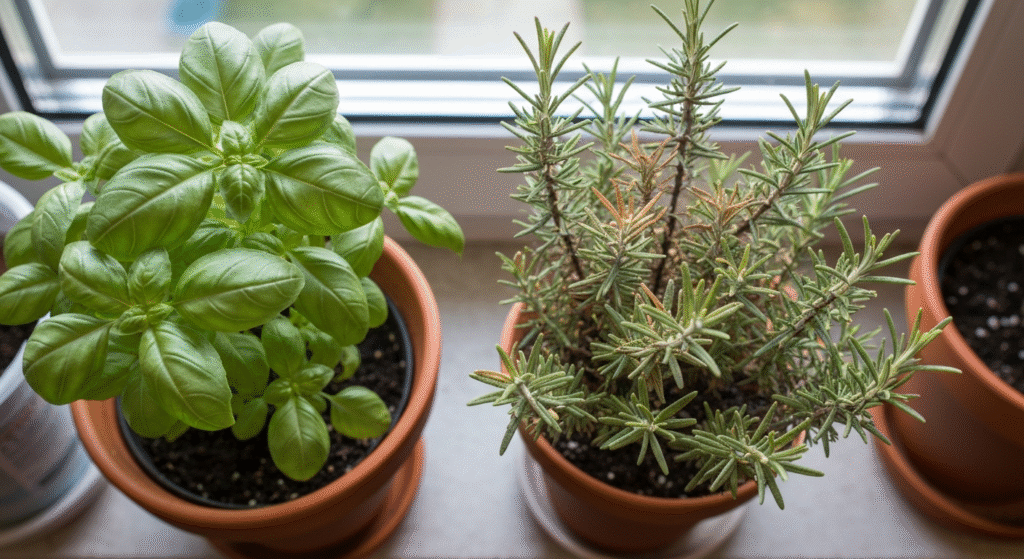
The problem usually isn’t neglect; it is a misunderstanding of origin. We tend to group all “kitchen herbs” into one category, assuming they all want the same environment. The reality is that your basil and your rosemary come from entirely different worlds. Treating a Mediterranean woody herb like a tropical tender herb is the fastest way to kill it.
My name is Wissam Saddique, and I run Trend Tales Park. I got into indoor container herb gardening after trying to keep a few basic herbs alive in a small apartment and realizing how little straightforward information existed for people working with limited space.
To be completely honest, I killed two beautiful rosemary plants and a pot of thyme before I understood they need completely different care than basil. I was watering my rosemary every time I watered my basil because I thought, “Hey, they are both plants, they both need water.” What started as a simple attempt to grow basil on a windowsill gradually became a more deliberate process of testing different containers, light setups, soil mixes, and growing routines. Through that trial and error, I learned that success comes down to replicating the environment where these plants naturally grow.
The Tale of Two Climates: Understanding the Origins
To keep these plants alive in your living room, you have to understand where they come from. This isn’t just trivia; it dictates every part of their care.
Basil is native to tropical and subtropical regions (like India and Southeast Asia). Think about those environments. They are humid, the soil is rich and consistently moist, and the sun is filtered through moist air. Basil is a “tender” herb. It has soft stems and high water content in its leaves. It wilts quickly when it’s thirsty because it relies on water pressure to stand up straight.
Rosemary, Thyme, Oregano, and Sage are Mediterranean herbs. They evolved in places like the rocky coasts of Greece, Italy, and Spain. These environments are rugged. The soil is sandy and drains almost instantly. The sun is intense and unrelenting. The air is often dry and salty.
When you treat a Mediterranean herb like a tropical one, you are essentially drowning it. These plants have evolved to survive drought, poor soil, and blazing heat. When we bring them indoors and baby them with frequent water and rich, heavy soil, we are giving them too much of a good thing.
The Watering Divide: Moist vs. Dry Cycles
The single biggest reason indoor gardeners fail with rosemary and thyme is overwatering. I used to have a strict “Watering Wednesday” routine where I watered every single plant in my apartment. That routine was great for my leafy plants, but it was a death sentence for my woody herbs.
Here is the main difference I found in my routine:
- Basil: Likes to be kept consistently moist (but not soggy). If the top inch of soil feels dry, I water it. In my apartment, this usually means watering every 3-4 days.
- Rosemary/Thyme: These plants need to dry out. Their roots are prone to rot if they sit in damp soil. I let the soil dry out almost completely before I water them again. For my setup, this means watering every 10-14 days.
How to Check the Soil Correctly
I don’t use moisture meters because I’ve found them to be inconsistent in small pots. I use the “finger test,” but I do it differently for each herb type.
For basil, I stick my finger into the soil up to the first knuckle. If it feels dry there, I water.
For rosemary and thyme, I dig deeper. I check at least two inches down, or sometimes I check the drainage hole at the bottom of the pot. If I feel any moisture near the roots of my rosemary, I wait. It is always better to underwater a Mediterranean herb than to overwater it. These plants have woody stems that hold moisture, so they don’t wilt immediately like basil does.
I created this quick reference guide based on my own watering schedule. Please remember, your home’s humidity might be different, but the ratio remains the same.
| Feature | Basil (Tender Herb) | Rosemary & Thyme (Mediterranean) |
| Watering Frequency | High (Every 3-4 days) | Low (Every 10-14 days) |
| Soil Moisture Goal | Consistently moist like a wrung-out sponge | Cycles of wet and nearly dry |
| Reaction to Thirst | Wilts dramatically and visibly | Needles turn gray/brittle (often too late) |
| Root Sensitivity | Tolerates some moisture | Highly prone to root rot in wet soil |
Drainage: Why Standard Potting Mix Isn’t Enough
When I first started, I bought a bag of “All-Purpose Potting Soil” and used it for everything. My basil loved it because that soil is designed to hold onto water. My thyme, however, struggled.
Standard potting mixes often contain peat moss or coir, which are like sponges. For Mediterranean herbs, this “sponge” effect is dangerous. The roots of rosemary and thyme need to breathe. In the rocky cliffs of the Mediterranean, water rushes over the roots and drains away immediately. In a plastic pot with heavy soil, the water sits, chokes the roots, and causes rot.
I don’t use a completely different soil bag, but I do modify the mix for my woody herbs.
My Simple Drainage Adjustment
When I pot rosemary, thyme, or oregano, I take my standard organic potting mix and I add perlite. A lot of it.
For my basil, I use the soil straight from the bag.
For my rosemary, I mix roughly 3 parts soil to 1 part perlite.
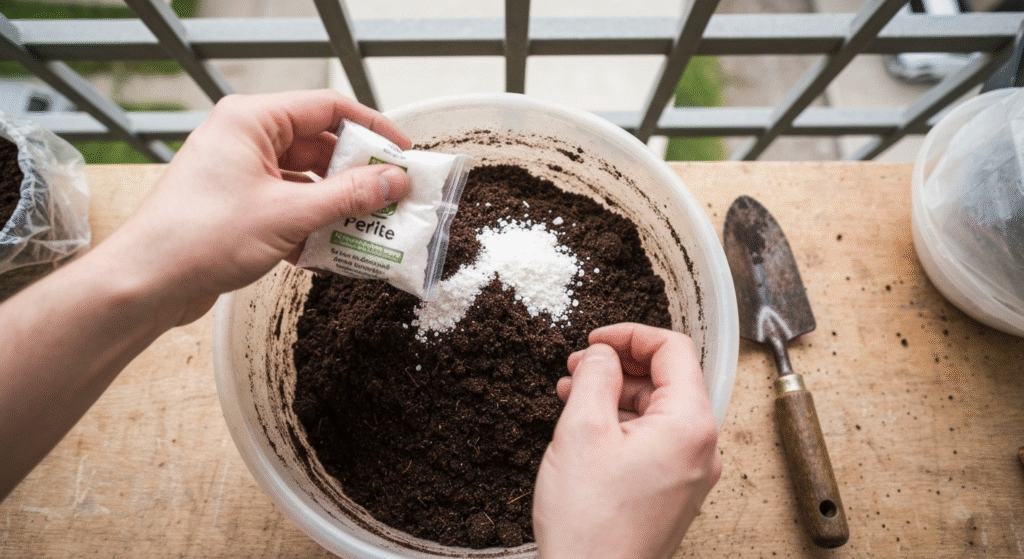
This mixture looks noticeably speckly with white rocks. The perlite creates air pockets in the soil. This ensures that when I do water the plant deeply, the excess water flows right out the bottom rather than sitting around the roots. If you grab a handful of this mix and squeeze it, it should fall apart immediately when you open your hand, not clump together in a ball.
Also, never leave standing water in the saucer under the pot. After I water my rosemary, I come back 20 minutes later and dump out any water that has drained into the saucer. Leaving a Mediterranean herb sitting in a puddle is the quickest way to kill it.
Light Requirements: The Sun-Seeking Truth
We often read that herbs need “full sun.” But in an apartment, “full sun” is a relative term. I learned that while basil can tolerate a bit of shade or a slightly dimmer window, rosemary and thyme are solar-powered beasts.
Basil is surprisingly adaptable. It thrives in 6-8 hours of light. In my apartment, I can get away with keeping basil in an east-facing window that gets good morning light but is shaded in the afternoon. It might grow a little slower, but it stays green and happy.
Rosemary and Thyme need high intensity. They want 8+ hours of direct light if possible.
I place my rosemary in my absolute brightest spot—a south-facing window where the light hits the leaves directly for most of the day. If you put rosemary in a shady corner or a north-facing window, it won’t die immediately. Instead, it will grow “leggy.” The stems will stretch out looking for light, the leaves will be spaced far apart, and the plant will weaken. A weak plant is much more susceptible to issues later on.
If you live in a space with very poor light, basil is the safer bet. If you are determined to grow rosemary in a dark apartment, you will likely need a grow light to supplement the sun. I haven’t had to use one yet because I prioritize my window space for the woody herbs, pushing the basil slightly to the side.
Pot Material: Plastic vs. Terra Cotta
This was a game-changer for me. In the beginning, I bought matching glazed ceramic pots for all my herbs because I wanted them to look nice. They looked great, but they trapped moisture.
Terra cotta (unglazed clay) is the best friend of Mediterranean herbs. Clay is porous. It actually wicks water away from the soil and lets it evaporate through the walls of the pot. This helps the soil dry out faster and lets air reach the roots.
For my basil, I actually prefer plastic or glazed ceramic pots. Since basil wants to stay moist, a plastic pot helps retain that water so I don’t have to water it every single day.
For my rosemary and thyme, I switched almost exclusively to terra cotta. It acts as a safety net. If I accidentally water a little too soon, the pot helps correct my mistake by pulling that excess moisture out. If you are a chronic over-waterer (like I was), switching your Mediterranean herbs to clay pots is the easiest fix you can make.
Temperature and Humidity Tolerance
Our apartments are usually temperature-controlled, which is good, but the humidity can be an issue.
Basil loves humidity. If your kitchen gets steamy when you cook, your basil enjoys that. It mimics the tropical air of its ancestors. In the winter, when the heater dries out the air, basil can sometimes suffer.
Rosemary and thyme, however, are very tolerant of dry air. They have tough, needle-like or small woody leaves designed to hold onto water. They don’t need misting (please don’t mist your rosemary—it can lead to mildew). They are perfectly happy in the dry air of a typical air-conditioned or heated apartment.
The one temperature thing to watch for is cold drafts. While rosemary is tough, it hates a freezing draft. I made the mistake once of leaving a pot of thyme on a windowsill that wasn’t sealed well during a winter storm. The freezing air blasting one side of the pot shocked the roots. Now, I move them just a few inches back from the glass when the temperature really drops outside.
Spotting the Signs of Distress
Recognizing when a plant is unhappy is a skill that takes time, but the signals are different for these two groups.
When Basil is unhappy:
It talks to you loud and clear. If it needs water, it droops dramatically. It looks sad and pathetic. But, you give it a cup of water, and an hour later, it’s standing tall again. It is very forgiving.
When Rosemary is unhappy:
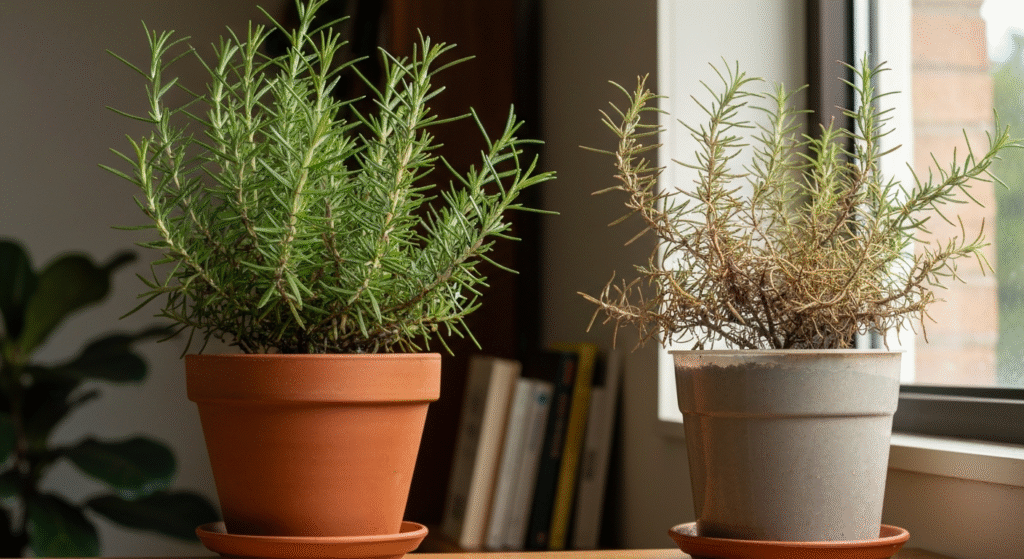
It is silent and stoic. Because the stems are woody, they don’t droop. By the time you notice rosemary looks “dry,” it is often already dead.
- Overwatering: The tips of the needles turn brown or black. The lower needles might turn yellow and fall off.
- Underwatering: The needles turn a dull gray-green and become brittle. If you touch the plant and a shower of dry needles falls off, it has been too dry for too long.
Thyme is similar. If you overwater thyme, the center of the plant often turns yellow and mushy. If you underwater it, the tiny leaves crisp up and shatter when you touch them.
Summary of Differences
To wrap up the comparison, here is how I mentally categorize my plant care now. I don’t treat the “herb garden” as one unit. I treat them as two separate zones.
Zone 1: The Tropical Zone (Basil)
- Pot: Plastic or Glazed
- Soil: Standard mix
- Water: Keep it moist, water frequently
- Light: Good light, but forgiving
Zone 2: The Mediterranean Zone (Rosemary, Thyme, Oregano)
- Pot: Terra Cotta
- Soil: Standard mix + extra Perlite (drainage!)
- Water: Let it dry out, water deeply but rarely
- Light: Maximum available sun
Understanding these differences changed everything for me. I stopped killing rosemary plants and started actually enjoying them. It wasn’t that I didn’t have a “green thumb”—it was just that I was using the wrong rulebook for the wrong plant.
For more detailed information on growing specific vegetables and herbs, I often refer to university resources like the University of Minnesota Extension, which offers excellent data on plant hardiness and care.
Frequently Asked Questions
Q: Can I plant basil and rosemary in the same pot?
A: No, you really shouldn’t. Because their water needs are opposites, one of them will suffer. If you water enough for the basil, you will drown the rosemary. If you keep the rosemary dry enough to be happy, the basil will dehydrate and die. Keep them in separate containers.
Q: My rosemary looks green but feels crispy. Is it dead?
A: Unfortunately, it likely is. Rosemary has a way of looking “alive” long after it has died because the needles hold their shape. If the needles crumble when you pinch them, the plant has dried out completely. Scratch the base of the stem with your fingernail; if it’s brown and dry underneath, it’s gone. If it’s green, there is still hope.
Q: Why does my thyme get moldy near the soil?
A: This is usually due to poor airflow and too much moisture. Thyme grows low and dense. If the soil stays wet and air can’t move through the leaves, fungal issues start. Water the soil directly (don’t pour water over the leaves) and ensure the soil dries out more between waterings.
Q: Do I need to mist my Mediterranean herbs?
A: No. Rosemary, thyme, and oregano do not need high humidity. Misting them can actually encourage fungal diseases like powdery mildew. They prefer dry foliage and dry air. Save the misting bottle for your tropical houseplants.
Final Thoughts
Gardening in a small space is about observation. Once I stopped trying to force my rosemary to act like basil, I found that it is actually a very low-maintenance plant. It doesn’t ask for much—just a sunny spot, a clay pot, and the discipline to walk away and let it be dry for a while.
If you are struggling, check your soil mix and your watering schedule first. Usually, the fix is simply doing less, not more.

