
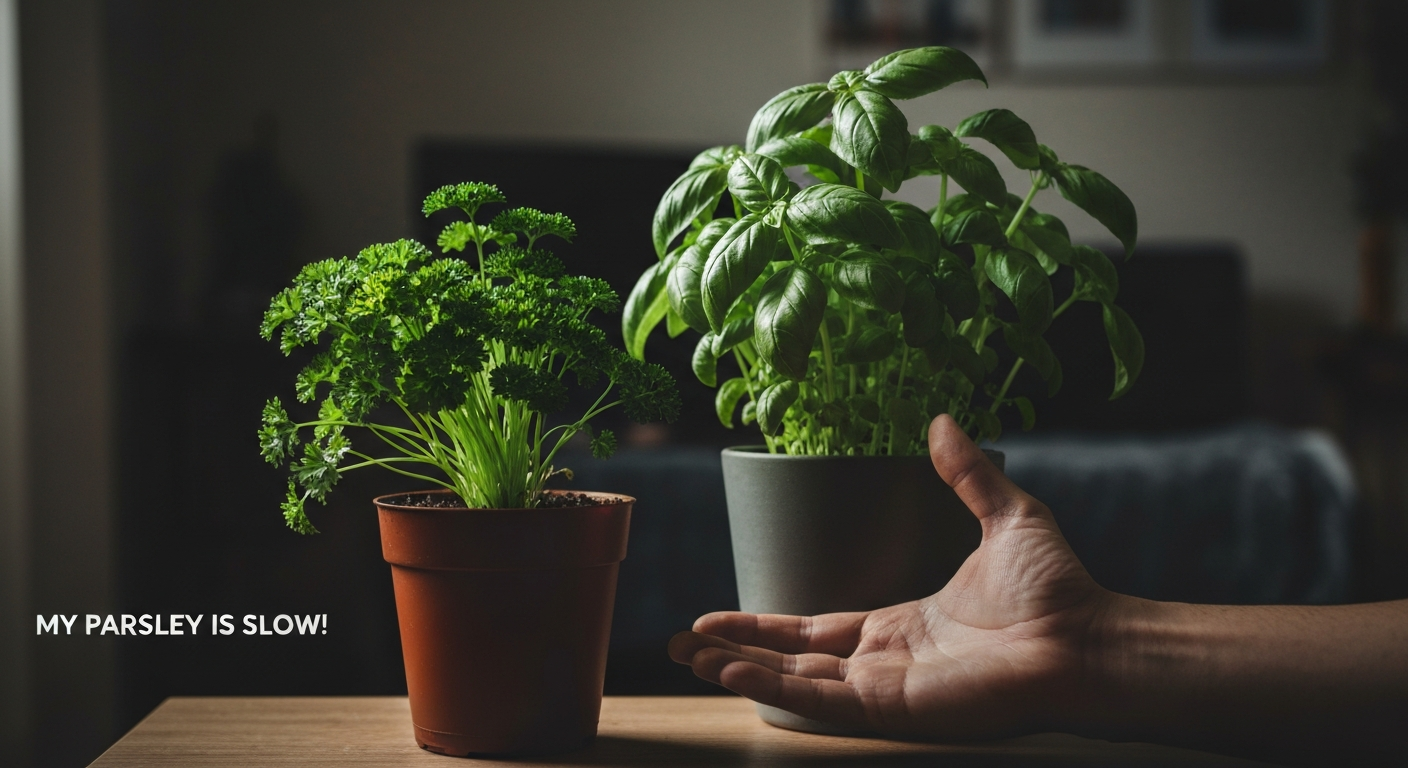
I used to think I was a bad gardener because my parsley wouldn’t keep up with my basil.
I’m Wissam Saddique. When I first started squeezing pots onto my apartment windowsills to run Trend Tales Park, I treated every herb the same. That was a massive mistake. I remember planting basil and parsley seeds on the exact same Saturday morning. By week three, we were putting fresh basil on pizza. The parsley? It was just a tiny, stubborn sprout that looked like it had given up on life.
I spent weeks convinced I had killed it. I tweaked the lights, I poked the soil, and I stared at it. It turns out, I wasn’t doing anything wrong—I just didn’t understand that parsley plays by a completely different set of rules.
If you are staring at a pot of parsley that seems frozen in time while the rest of your indoor garden is exploding with growth, this post is for you. We are going to talk about why this herb is the “tortoise” of the container garden, how to adjust your expectations, and most importantly, how to harvest it without accidentally setting it back another month.
Understanding the “Parsley Pause”
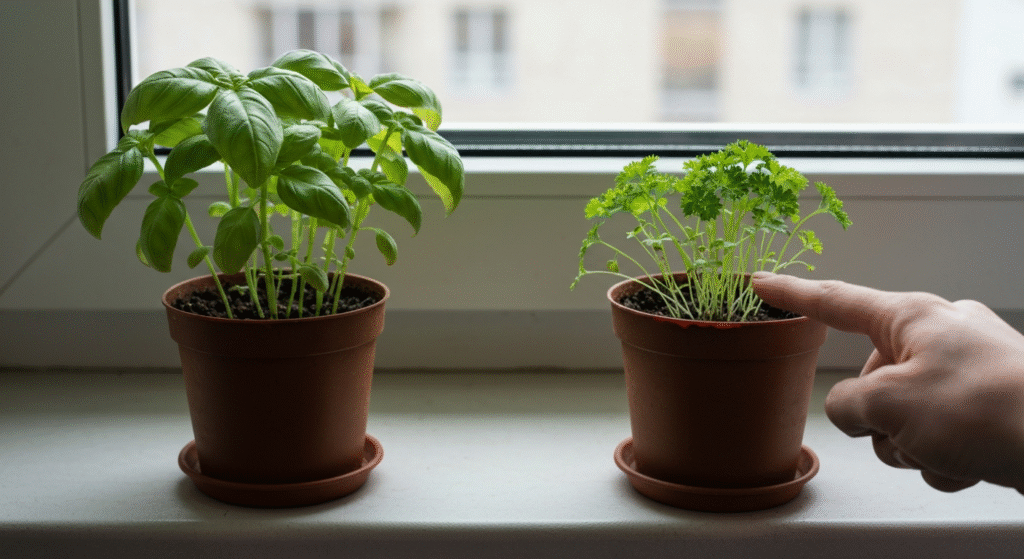
When you grow herbs in a small space, it is easy to assume green means “go.” But biologically, parsley is doing something very different than basil or cilantro. Basil is an annual that wants to race to flower and die before winter. It is programmed for speed.
Parsley is a biennial. Its goal in life is to survive two years. In that first year—the stage you are growing it in—it doesn’t care about getting tall fast. It cares about building a massive energy reserve.
While my basil was busy making leaves, my parsley was secretly pouring all its energy into a thick, carrot-like taproot. I couldn’t see this happening, so I assumed the plant was stalled. It wasn’t stalled; it was building a foundation. This taproot is what allows parsley to survive cold snaps that would kill basil instantly, but it also means the foliage growth feels agonizingly slow in the beginning.
You have to shift your mindset. You aren’t growing a sprinter; you are growing a marathon runner. If you try to force it to sprint with too much fertilizer or over-harvesting, you will exhaust it.
My 10-Week Timeline: Basil vs. Parsley
To help you visualize this, I tracked the growth of my two most common herbs side-by-side during my last winter grow cycle. Seeing the difference on paper really helped me stop panicking when the parsley didn’t look like a bush in a month.
I keep a grow journal (messy, coffee-stained, but useful), and here is exactly how the timeline shook out for me.
The Early Days (Weeks 1-4)
For the first month, the difference is laughable. My basil seedlings were fighting for space, doubling in size every few days once the true leaves hit. The parsley was delicate and thread-like. I actually almost threw the parsley out in week 4 because I thought it had “damped off” or died. It hadn’t. It was just sitting there, establishing that root system.
The Middle Grind (Weeks 5-8)
This is the danger zone for impatience. By week 6, I was harvesting basil regularly. I had so much I had to freeze some. The parsley had finally started to look like a real plant, with that signature curly texture (I grow the curly variety mostly, though flat-leaf is similar in speed), but it was short.
I made a critical error around this time in my first year: I tried to harvest a “sprig” in week 6. It was too early. The plant didn’t have the solar panels (leaves) to recover quickly, and it just sat there, wounded, for weeks.
The Harvest Window (Weeks 9-12)
Finally, around week 10, the parsley hit its stride. The stems thickened up, and new growth started pushing from the center more aggressively. It took nearly three times as long as the basil to reach a point where I felt comfortable cutting it for dinner without guilt.
Here is the breakdown of what I saw in my apartment setup:
| Growth Stage | Basil (The Sprinter) | Parsley (The Marathoner) |
| Germination | fast (5-7 days). | Slow and erratic (14-25 days). |
| First True Leaves | Visible by Week 2. | Barely visible by Week 3-4. |
| Harvest Ready | Ready to snip by Week 3-4. | Do not touch until Week 10-12. |
| Regrowth Speed | Explosive (days). | Moderate/Slow (weeks). |
| Light Needs | High intensity needed for speed. | Tolerates lower light, but grows slower. |
Note: My apartment is pretty dry in the winter, which might slow things down a bit compared to a humid greenhouse, but this is a realistic timeline for a standard indoor setup.
Light Intensity and Growth Speed
One factor that makes the “slow growth” problem worse is light. I learned this the hard way when I tried to grow parsley on a bookshelf that was about four feet away from the window.
Parsley is often sold as an herb that tolerates partial shade. While that is true—it won’t die in lower light—it also won’t grow. In low light, parsley enters a sort of stasis. The metabolism of the plant slows down to match the energy input.
If your parsley is growing even slower than the timeline I mentioned above, check your stems. Are they long, pale, and falling over? That is “legginess.” It means the plant is stretching desperately to find fuel.
I found that placing my parsley directly under my LED grow lights (about 6 inches below the diodes) didn’t make it grow as fast as basil, but it made the stems sturdy. A sturdy stem is crucial because that is the pipeline that moves water and nutrients from that big taproot up to the leaves. If you have weak, skinny stems from low light, the harvest will never really arrive.
If you are relying on natural window light, you have to accept that winter growth will be glacial. The days are shorter, and the sun is weaker. During December and January, I don’t really “grow” parsley; I just maintain it. I accept that it’s not going to produce enough for a tabbouleh salad every week.
The Patience Limit: Is It Dead or Just Thinking?
How do you know if your plant is actually healthy and just being slow, versus actually struggling? This is a question I ask myself a lot.
I look for color and center growth. Healthy parsley, even when it is small, should be a deep, vibrant green. If the new leaves coming out of the center (the crown) are yellow, or if the tips are browning, that isn’t a “slow growth” issue—that is a water or nutrient issue.
However, if the plant is green, upright, and the center has tiny little unfurling leaves that just don’t seem to get bigger, take a breath. It’s fine. It is just working on the roots. I have had parsley plants sit unchanged for three weeks and then suddenly push out four new stems in a few days.
It helps to think of parsley growth in “flushes.” It gathers energy, pushes a flush of leaves, and then rests to recharge. Basil, by comparison, is a continuous stream of growth. If you expect the stream, the flush-and-rest cycle looks like failure. It’s not.
Safe Harvesting: The 1/3 Rule
This is where most indoor gardeners (including me) ruin their hard work. Because parsley takes so long to grow, every leaf is precious. When you finally have a decent clump, the temptation is to cut a big bunch for a recipe.
Don’t do it.
If you cut 50% of a basil plant, it will probably bounce back in a week. If you cut 50% of a young parsley plant, you might stunt it for a month or kill it entirely. The plant needs those leaves to photosynthesize and keep that taproot alive.
The Mistake I Made
I mentioned earlier that I cut too much in week 6. I wanted a garnish for a pasta dish, so I grabbed a handful of stems—probably half the plant—and snipped them.
The plant went into shock. It stopped drinking water (the soil stayed wet for days, which is a bad sign), and the remaining leaves started to yellow. It took three full weeks before I saw a single new leaf emerge from the center. I cost myself almost a month of harvest by being greedy for one meal.
The Right Way to Cut
Now, I follow a strict rule: never take more than one-third of the plant at a time. And frankly, if the plant is young (under 12 weeks), I stick to maybe 20%.
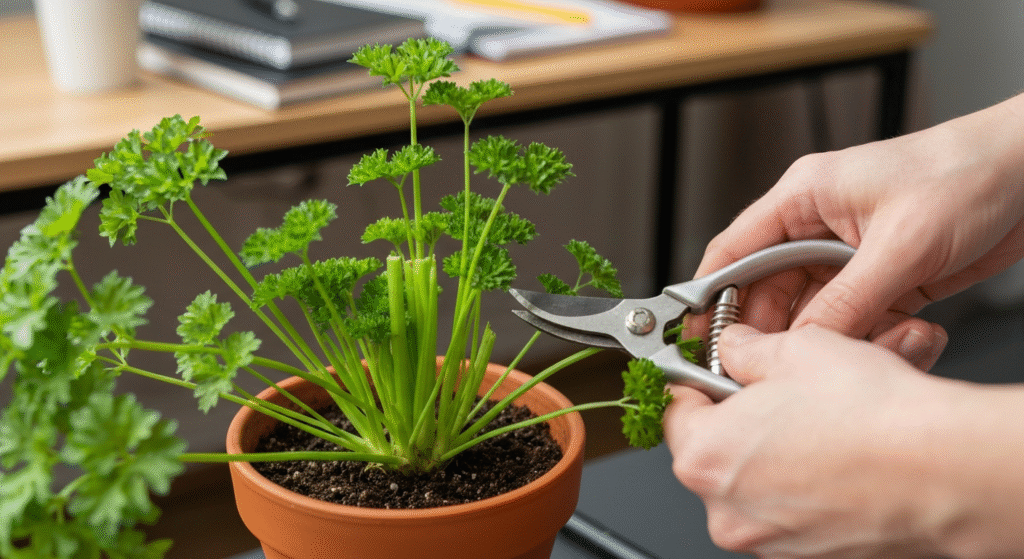
You must harvest from the outside in. The “crown” is the center point where the new baby leaves emerge. That is the future of your plant. If you cut the tiny baby leaves in the center, you are effectively shutting down the factory.
I always look for the oldest, largest stems on the outer perimeter of the clump. These stems have done their job. They are usually thicker and sometimes tough, but they are full of flavor. By removing them, you trigger the plant to say, “Hey, I lost some solar panels, I better inflate those baby leaves in the center to replace them.”
- Identify the “crown” (the cluster of tiny leaves in the middle).
- Find an outer stem that is leaning away from the center.
- Follow that stem all the way down to the soil line.
- Snip it cleanly near the base. Do not leave a weird 2-inch nub; it will just rot.
The Recovery Phase
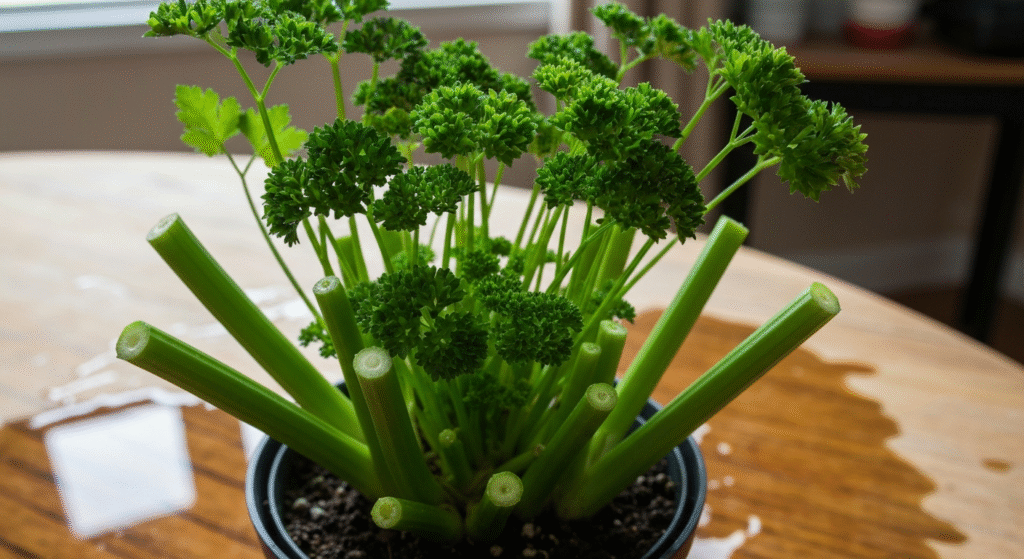
After you harvest, even if you do it gently, the plant needs a minute.
With basil, I harvest and then immediately fertilize to fuel the next round. With parsley, I am more careful. Since it grows slower, it eats slower. If I harvest a few stems and then dump a bunch of high-nitrogen fertilizer on it, I risk burning the roots because the plant isn’t cycling nutrients fast enough to use it all.
I usually wait a few days after harvesting to see how the plant reacts. If it keeps perking up and the center leaves are green, I might give it a very weak dose of liquid feed. But generally, patience is the better fuel here.
I also rotate the pot after every harvest. Usually, the plant leans toward the light. I harvest the stems on the “back” side (the side away from the window), then turn the pot 180 degrees. This puts the smaller, center leaves in the direct light, encouraging them to grow out and become the next harvest.
Why This Matters for Small Spaces
In a small apartment, every pot has to earn its rent. I used to get frustrated that parsley wasn’t “earning” its spot because it wasn’t producing volume.
But once I realized that parsley provides fresh flavor for months and months—long after the basil has bolted and turned bitter—I started respecting the slow burn. My indoor parsley plants usually last me 6 to 9 months before they try to flower or get too woody. That is a long-term relationship compared to the brief fling I have with cilantro.
If you are struggling with space, you might be tempted to overcrowd the pot to get more harvest. I tried planting three parsley starts in one small 6-inch pot. It was a disaster. Their taproots got tangled, they fought for nutrients, and none of them thrived. One healthy, slow-growing plant in a dedicated pot will eventually out-produce three crowded, stressed ones.
Frequently Asked Questions
Why are my parsley stems falling over?
This is almost always a light issue. The stems are stretching to find the sun, becoming too weak to support the weight of the leaves. Move the pot closer to your light source or window. If they are already flopping, you can’t “fix” the old stems, but better light will make the new growth sturdy.
Can I harvest parsley if it only has three stalks?
No. If you have a tiny plant with only three or four mature stalks, let it grow. If you cut one, you are removing 25-33% of its energy source. Wait until you have at least 8-10 separate stems before you start taking any.
Does cutting parsley make it grow faster?
Not exactly. It’s not like ahydra where cutting one head spawns two immediately. Cutting outer stems signals the plant to focus energy on the center new growth, but it doesn’t speed up the plant’s metabolism. It just redirects resources.
Why is my parsley growing tall instead of bushy?
If the center stem is shooting straight up and looking different than the leaves, it might be “bolting” (going to flower). This usually happens in the second year or if the plant gets stressed by extreme heat. Once it bolts, the flavor changes and becomes bitter. Indoors, this is rare in the first year unless your apartment is extremely hot.
It takes time to get the rhythm of indoor herbs. If you are used to buying big bunches at the grocery store for a dollar, the pace of growing it yourself can feel underwhelming. But the flavor of a parsley leaf that you just snipped—one that hasn’t sat in a fridge truck for a week—is intense. You need less of it to get the flavor you want.
So, stop comparing your parsley to your basil. Let it be the tortoise. Give it deep watering, decent light, and a lot of personal space, and it will eventually reward you with a steady, reliable harvest that lasts all winter.
According to the University of Minnesota Extension, parsley is technically a biennial, which explains that deep root investment I mentioned earlier—it’s playing the long game for survival, not just quick growth.

