
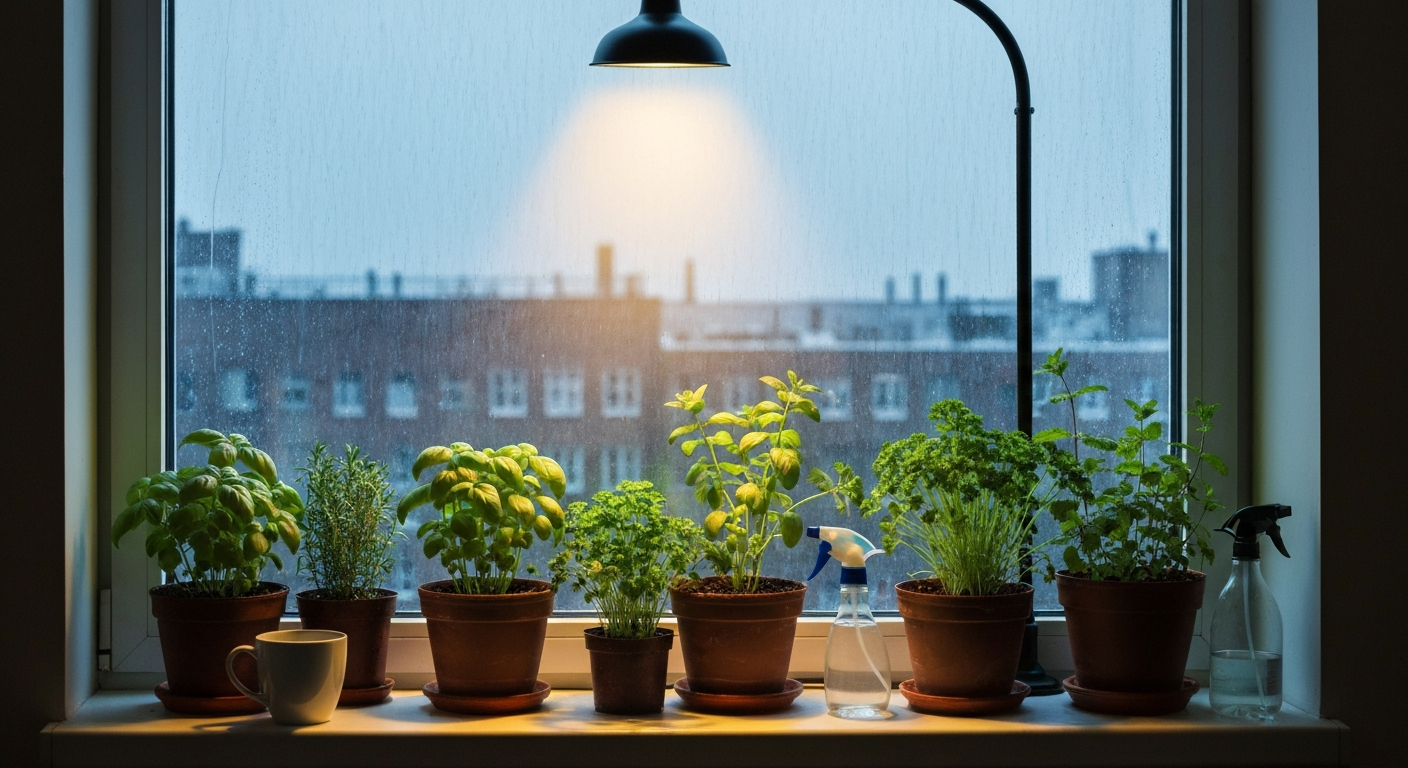
Winter is the ultimate reality check for indoor gardeners. You spend all summer feeling confident, watching your basil explode with new leaves and your mint try to take over the windowsill. Then, somewhere around mid-November, things shift. The growth stops. Leaves turn pale or yellow. Stems that were once sturdy start stretching out, looking thin and desperate.
If you are seeing this, you aren’t failing as a gardener. You are just fighting physics.
My name is Wissam Saddique. When I first started Trend Tales Park, I was living in a small apartment with decent windows but very little knowledge of seasonal shifts. I remember my first winter trying to keep a basil plant alive on a windowsill. I changed nothing about my routine. I watered it the same. I kept it in the same spot. Yet, by December, it looked exhausted. It took me a while—and a few dead plants—to realize that while my apartment looked the same to me, it was a completely different environment for the plants. Through a lot of trial and error with soil mixes and lighting setups in limited space, I learned that keeping herbs alive in winter isn’t about pushing for growth. It is about maintenance and survival.
This guide covers exactly what happens to your light during the cold months and the specific adjustments I make to pull my container garden through to spring.
Why Your Windowsill Betrays You in December
The biggest mistake I made early on was assuming that a “sunny window” is a static thing. It isn’t. The quality of light hitting your glass changes drastically between July and December.
In the summer, the sun is high in the sky. The light is intense, direct, and lasts for 14 to 16 hours a day. In winter, the sun sits much lower on the horizon. The rays come in at a sharp angle, passing through more atmosphere before they even reach your window. By the time that light gets through your double-paned glass, it has lost a massive amount of energy.
To a human eye, the room might still look bright enough to read a book. But plants don’t see light the way we do; they consume it. For a herb like rosemary or basil, the drop in light intensity during winter is the equivalent of putting them on a starvation diet.
The “Short Day” Trigger
It’s not just about brightness; it is about duration. Most culinary herbs require at least 6 to 8 hours of direct sunlight to thrive. In winter, depending on where you live, you might only get 9 hours of daylight total. If your window faces east or west, your plants might only get 2 or 3 hours of actual direct sun before the angle shifts and the light is gone.
When the days get short, many plants trigger a dormancy response. They slow down metabolic processes because they know they don’t have the fuel to support new leaves. If you try to force them to grow during this time—usually by overwatering or over-fertilizing—you will likely kill them.
Recognizing the Signals: It’s Not Just “Dying”
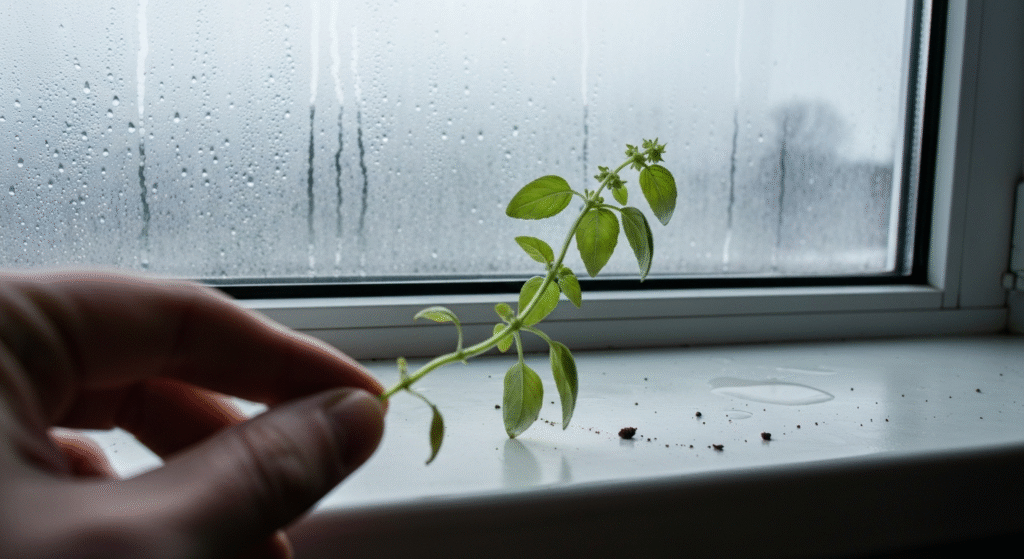
Your herbs will tell you they are light-starved long before they actually die. The symptoms are consistent, but they are often misdiagnosed as watering issues.
When I first saw my herbs struggling in winter, I assumed they were thirsty. I watered them more, which only rotted the roots because the plant wasn’t photosynthesizing fast enough to drink the water. You need to look for specific structural changes in the plant.
Etiolation (The Stretch)
This is the most common symptom. You will see the stem grow rapidly, but it looks thin and weak. The space between the leaves (internodes) gets longer.
The plant is literally stretching itself out, trying to find a light source. It’s a survival mechanism. In the wild, if a plant is shaded by a neighbor, growing taller helps it break through the canopy. On your windowsill, there is no canopy to break through. It just keeps stretching until it can no longer support its own weight and falls over.
Leaning
If your plants look like they are trying to escape out the window, they are phototropic. They are bending toward the strongest source of blue light. While some leaning is normal, severe leaning where the stem curves at a 45-degree angle indicates the light source is too weak and too directional.
Pale or Yellowing Leaves
Chlorophyll is what makes leaves green, and it is expensive for the plant to produce. It requires energy. When light drops, the plant stops producing as much chlorophyll. Older leaves might turn yellow and drop off. This is the plant deciding it can’t support a large family anymore, so it evicts the oldest members to save the main stem.
Which Herbs Struggle vs. Which Survive
Not all herbs handle the winter gloom the same way. Through my years of testing different containers and layouts in my apartment, I’ve found there is a distinct hierarchy of tolerance. Knowing which of your plants is a “drama queen” and which is a “survivor” helps you prioritize that prime real estate right up against the glass.
I learned this the hard way when I gave my prime window spot to a mint plant (which would have been fine in the shade) while my rosemary slowly perished in a darker corner.
The High-Light Demanders
These plants are native to the Mediterranean. They are used to baking hot sun and rocky, dry soil. They suffer the most in a dim winter apartment.
- Rosemary: This is the toughest one to keep happy indoors. If it doesn’t get bright light, it tends to get powdery mildew or dry out brittle.
- Basil: Basil hates the cold and craves the sun. In many cases, it is better to harvest your basil and make pesto in October rather than fighting to keep a large plant alive till March. It rarely survives a dark winter without help.
- Thyme: Similar to rosemary, it needs light to keep its flavor oils concentrated.
- Sage: It becomes very leggy and susceptible to rot in low light.
The Moderate-Light Tolerators
These herbs will slow down, but they usually won’t die if the light drops a bit.
- Parsley: I’ve had parsley sit in a north-facing window all winter. It didn’t grow much, but it stayed green and gave me fresh leaves for cooking.
- Chives: Very resilient. They might go dormant and look ragged, but they bounce back fast.
- Oregano: Surprisingly tough. It tolerates lower light better than its cousin, thyme.
The Low-Light Survivors
If you have a dark corner or a window blocked by a building, these are your best bets.
- Mint: Mint is basically a weed. It will survive the apocalypse. It will get leggy in winter, but it rarely dies from lack of light alone.
- Lemon Balm: Part of the mint family, shares the same resilience.
Here is a quick breakdown of how I prioritize my window space:
| Priority Level | Herb Type | Winter Window Position | Signs of Low Light Stress |
| Priority 1 | Rosemary, Basil | South-facing, directly against glass | Dropping needles, blackening leaves |
| Priority 2 | Thyme, Sage | South or West-facing | Thin, stretching stems |
| Priority 3 | Parsley, Chives | East or West-facing | Slow growth (normal) |
| Priority 4 | Mint, Lemon Balm | North-facing or indirect light | Long stems, small leaves |
Note: I treat this table as a strict seating chart. If I have limited south-facing window space, the rosemary gets it. The mint can sit on the floor if it has to.
The Practical Fix: Maximizing Natural Light
Before you go out and buy equipment, you should do everything possible to use the free light you have. Since I garden in a small space, I have to get creative with positioning.
The light intensity drops off drastically for every inch you move away from the window. This is called the Inverse Square Law. A plant sitting 2 feet away from the window receives only about 25% of the light intensity compared to a plant sitting right against the glass.
The Window Rotation
I rotate my pots 90 degrees every time I water them, which is roughly once a week in winter. This prevents the “lean.” If you don’t rotate them, the side facing the room will eventually wither because it is effectively in deep shade compared to the window side.
Clean Your Glass
This sounds trivial, but it matters. Winter windows get dirty from rain, snow, and condensation. A layer of grime can reduce light transmission by 10%. When your plants are already on the edge of starvation, that 10% matters. I wipe down the inside and outside (if accessible) of my herb windows in late November.
Reflection Hacks
In my first apartment, I had a very dark corner where I wanted to keep herbs. I couldn’t add a window, so I added mirrors. Placing a small mirror behind the plants reflects the window light back onto the “dark side” of the plant. You can also use white poster board. It isn’t high-tech, but it bounces wandering photons back toward the leaves.
Crossing the Bridge: When to Use Grow Lights
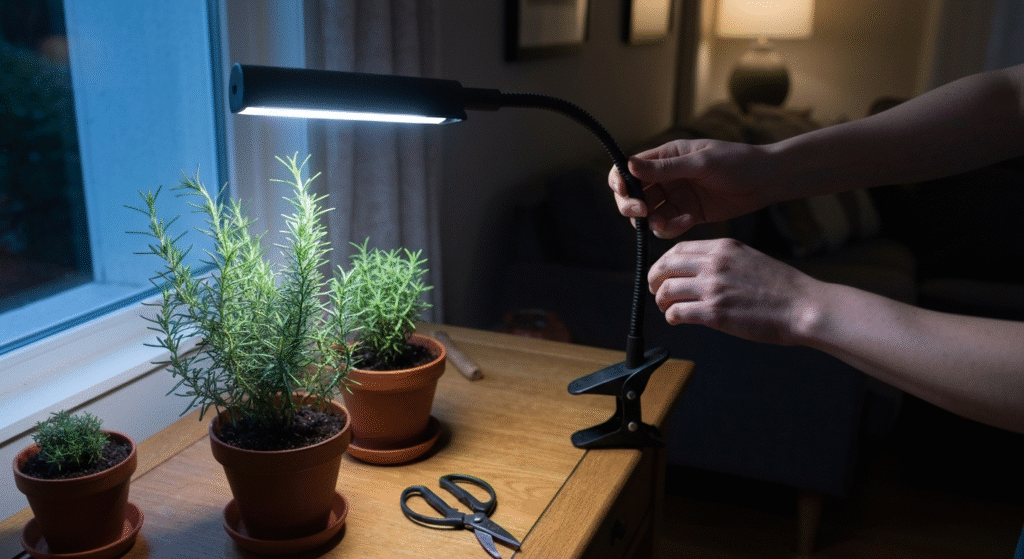
Sometimes, despite your best efforts, natural light just isn’t enough. If you live in a northern latitude or your apartment faces north, your basil will not survive winter without help.
I used to be intimidated by grow lights. I thought they were expensive, purple-glowing monstrosities that required drilling into the ceiling. I was wrong.
The “Bridge” Strategy
You don’t need a professional greenhouse setup. You are just trying to bridge the gap between the 8 hours of weak daylight you have and the 12 hours the plant wants.
I bought a simple $25 clip-on LED grow light with three bendable arms. It clips onto the side of my shelf. I don’t leave it on 24/7. I use it to extend the day.
- My Routine: When the sun starts to set around 4:30 PM, I turn the grow light on.
- Duration: I leave it on for about 4 to 5 hours, turning it off when I go to bed.
- Result: The plants get a total of 12+ hours of light.
Full Spectrum vs. Purple
You will see a lot of “blurple” (blue and red) lights. They work, but they make your living room look like a nightclub. For a home grower, look for “Full Spectrum” white LED lights. They are pleasant to look at, blend in with your home decor, and provide the wavelengths your herbs need.
Distance Matters
LEDs are cool to the touch, which means you can get them close to the plant. I keep my lights about 4 to 6 inches above the top leaves of the basil and rosemary. If the light is 2 feet away, it’s doing almost nothing.
I tested this last year with two parsley plants. One had the light 6 inches away; the other had it 18 inches away. The one with the close light stayed bushy and dense. The other one stretched out as if the light wasn’t even there.
Adjusting Water and Temperature
Light is the engine that drives the plant’s metabolism. When you reduce the light (fuel), the engine slows down. If the engine is slow, it uses less water.
The most dangerous thing you can do in winter is water your herbs on your summer schedule. In July, I water my basil every two days. In January, if I did that, the roots would rot within two weeks.
The Finger Test
I stop looking at the calendar and start feeling the soil. Stick your finger an inch into the soil. In winter, I wait until the soil is dry almost to the bottom of the pot for drought-tolerant herbs like rosemary. For leafy herbs like parsley, I let the top inch dry out completely.
Because the sun is weak, evaporation is low. A pot that took 2 days to dry in summer might take 10 days to dry in winter.
The Radiator Battle
While plants hate the cold, they hate dry heat more. In many apartments, the heater vents are located right under the windows—exactly where you put your plants for light.
Hot air blowing directly on herbs will turn them into crispy sticks overnight. It lowers the humidity drastically.
- The Fix: I use simple plastic air deflectors on my vents to push the air into the room rather than up at the plants.
- Humidity: I group my plants together. Plants release moisture (transpiration), so grouping them creates a small microclimate of higher humidity. I also keep them on a tray filled with pebbles and a little water. The pot sits on the pebbles, not in the water. As the water evaporates, it humidifies the air around the leaves.
Managing Expectations: The “Slow Down”
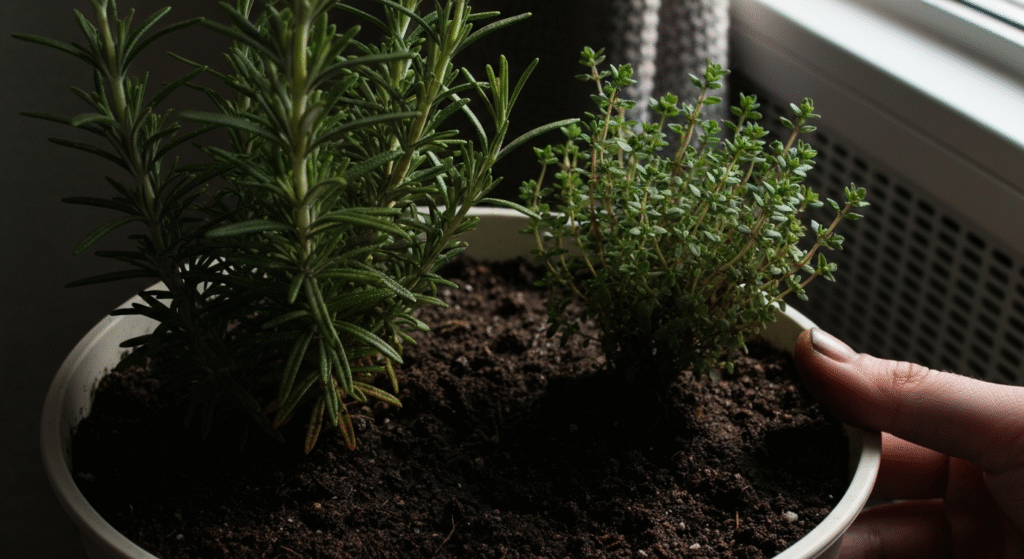
This is the mental shift every indoor gardener needs to make. Your goal in winter is not a bumper crop. Your goal is survival.
Even with my clip-on lights and careful watering, my herbs don’t grow fast in January. They pause. They maintain. And that is okay.
I used to get frustrated that my basil wasn’t producing enough for a weekly pesto pasta. I tried to force it with fertilizer. I added liquid plant food in December, hoping to kickstart growth. All I did was burn the roots and create weak, spindly growth that attracted bugs.
Now, I stop fertilizing completely from November to March. I let the plants rest. I harvest very sparingly—maybe a few leaves of rosemary for a roast chicken, or some chives for eggs—but I don’t do any heavy pruning. I treat my indoor garden like it’s in hibernation.
Dealing with Leaf Drop Panic
It is normal for your herbs to drop a few leaves when the season changes. We turn on our heaters, the humidity drops, and the light spectrum changes. The plant reacts by shedding older leaves to conserve water.
If you see leaves dropping, do not panic. Do not immediately water it. Check the soil first. If the soil is damp and leaves are dropping, you are overwatering. If the soil is bone dry, give it a drink. But often, it’s just the plant adjusting to the new reality of the season.
FAQs
1. Do I really need a grow light for indoor herbs in winter?
For Mediterranean herbs like basil, rosemary, and thyme, usually yes. Unless you have a large, unobstructed south-facing window, natural winter light is too weak. However, tolerant herbs like mint and parsley can often survive on a windowsill without extra help, provided you accept slower growth.
2. Why are my herb leaves turning pale green or yellow in winter?
This is almost always a lack of light. The plant is producing less chlorophyll because it doesn’t have the solar energy to maintain it. If the leaves are yellowing and the soil is wet, it could also be root rot caused by overwatering during the low-light season.
3. Can I leave my grow lights on 24 hours a day to make them grow faster?
No. Plants need a dark cycle to rest and process the energy they gathered during the day. Leaving lights on 24/7 confuses their biological clock and can actually stunt their growth or cause different stress issues. Aim for 12 to 14 hours of light total.
4. Should I fertilize my herbs in winter to help them perk up?
Avoid fertilizing in winter. Because light is low, the plant’s metabolism is slow. Adding fertilizer is like forcing a sleeping person to eat a heavy meal. The plant can’t use the nutrients, so they build up in the soil and can burn the roots. Wait until you see natural new growth in spring.
Conclusion
Keeping herbs alive through winter feels like a balancing act because it is one. You are constantly monitoring the trade-off between light, water, and temperature.
My biggest takeaway from years of apartment gardening is that you have to listen to the plant, not the calendar. If the soil is still wet after a week, don’t water it. If the basil is leaning, move it closer to the glass or turn on a lamp. Don’t expect summer results in winter conditions.
If you can get your herbs to March with green leaves and healthy stems, you have won. As soon as the spring sun hits that window, they will wake up, and you will be ready for another season of fresh flavors.
For more detailed information on light requirements and plant responses, I recommend checking out this guide on Lighting for Indoor Plants from the University of Minnesota Extension.

