
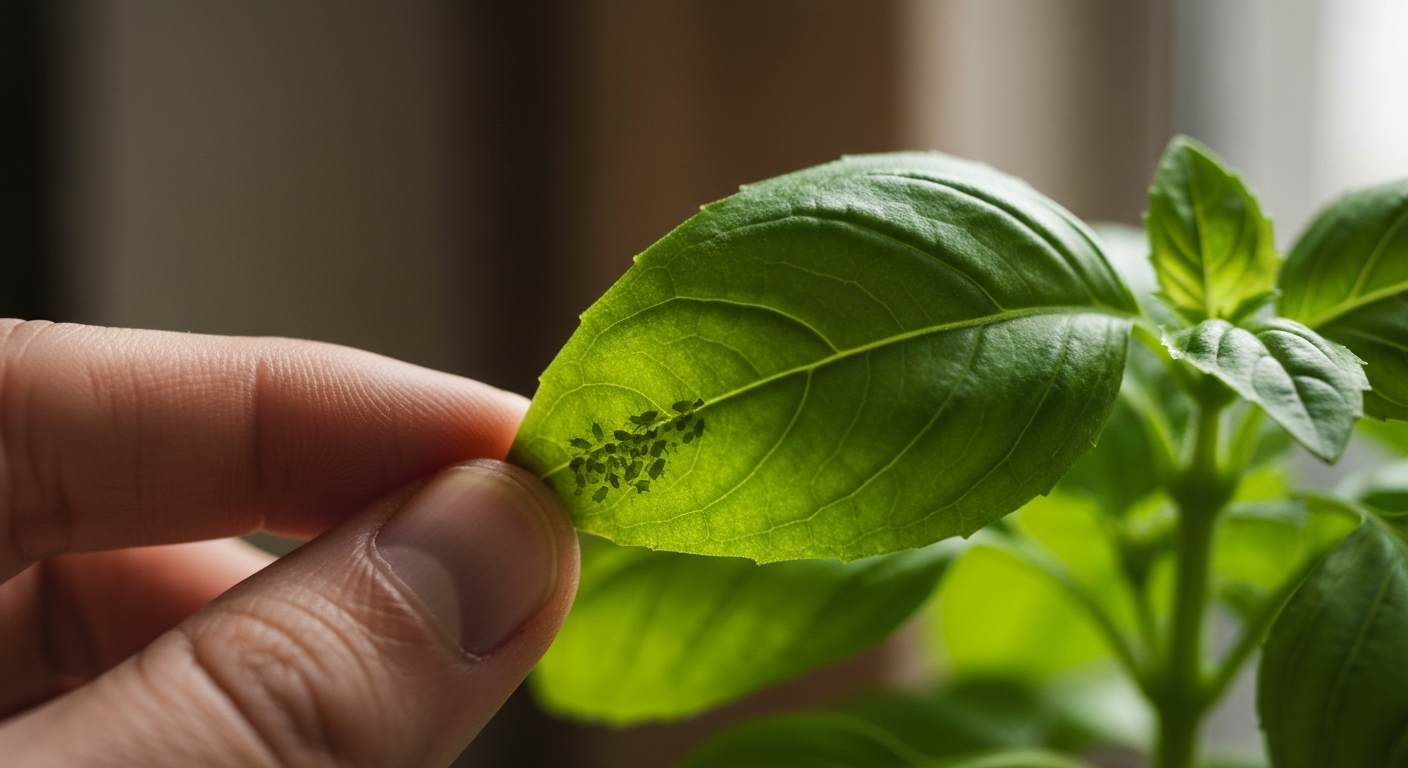
You know that feeling when you finally get your basil looking lush and green, you go to pinch off a leaf for dinner, and suddenly a tiny black speck flies right up your nose? Or maybe you notice the leaves looking a bit sticky, or covered in strange, fine webbing.
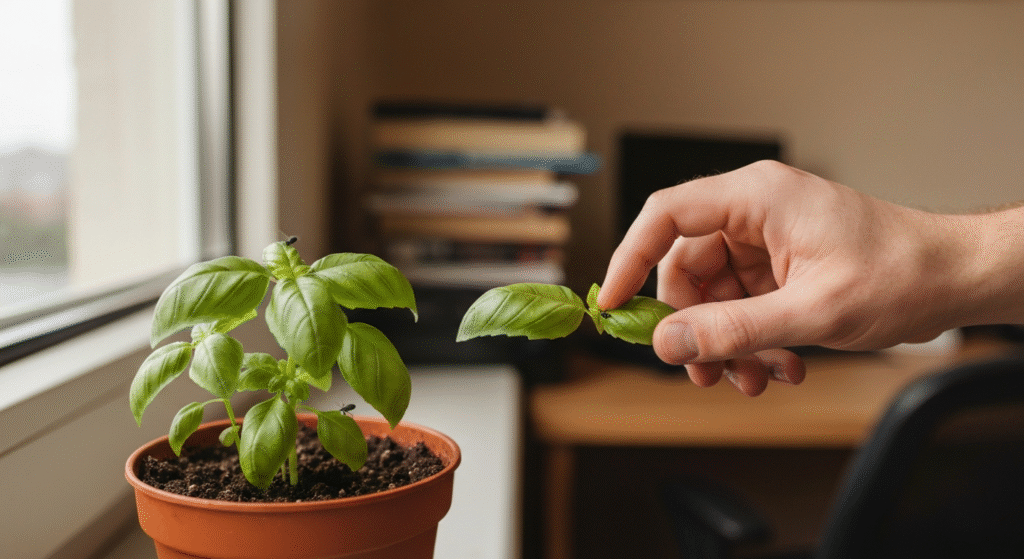
It’s a sinking feeling. You bring nature inside to make your apartment feel alive, not to start an insect farm.
When I first started gardening indoors, I panicked the first time I saw bugs. I thought I had to throw everything out and start over. I assumed I was just “bad” at plants or that my apartment was dirty. But the truth is, pests are a normal part of growing food, even indoors. They hitch rides on new plants from the nursery or even come in through open window screens.
The good news is that you don’t need harsh chemicals to fix this. In a small space, you definitely don’t want to be spraying strong pesticides where you eat and sleep.
A Little Background on My Battle with Bugs
My name is Wissam Saddique. I got into indoor container herb gardening after trying to keep a few basic herbs alive in a small apartment and realizing how little straightforward information existed for people working with limited space. What started as a simple attempt to grow basil on a windowsill gradually became a more deliberate process of testing different containers, light setups, soil mixes, and growing routines.
Along the way, I’ve dealt with more bug infestations than I care to admit. I’m not an entomologist or a commercial farmer. I’m just a guy who really likes fresh mint and hates seeing his plants getting eaten. Everything I’m sharing here is based on what I actually tried in my own living room. Some things worked, and some things—like that time I tried a garlic spray that made my whole apartment smell like a pizzeria for a week—didn’t work so well.
Here is a breakdown of the three most common intruders I’ve encountered: fungus gnats, aphids, and spider mites, and the specific steps I took to show them the door.
The Frequent Flyer: Fungus Gnats
If you see tiny black bugs hovering around the soil of your herbs or flying erratically near your face, these are almost certainly fungus gnats. They look a bit like fruit flies, but they aren’t interested in your bananas. They are interested in the damp soil where your herbs live.
In my experience, these are the single most annoying pests for indoor herb gardeners. They are usually the result of one thing: kindness. Or specifically, killing your plants with kindness by watering them too much.
How I Identified Them
I used to confuse these with fruit flies constantly. But I realized the difference when I watched where they landed. Fruit flies hang out in the kitchen near the trash or fruit bowl. Fungus gnats hang out on the rim of the plant pot or crawl across the soil surface.
I also noticed that my herbs weren’t growing as fast as they should. That’s because while the adult gnats are just annoying, their larvae (babies) live in the soil and can nibble on the roots of your herbs.
The Solution That Actually Worked
I tried a lot of “hacks” I found online, including putting cinnamon on the soil (did nothing for me) and apple cider vinegar traps (caught a few, but not enough). Here is the two-step process that finally cleared up my basil pot.
1. The “Dry Out” Method
Fungus gnats need moist soil to lay eggs. If the top layer of soil is dry, the cycle breaks. I stopped watering my herbs on a schedule and started waiting until the top two inches of soil were completely dry to the touch. My herbs drooped a tiny bit, but they survived. The gnats, however, had nowhere to lay eggs.
2. Yellow Sticky Traps
This was the game changer. I bought a pack of yellow sticky traps—they are just little pieces of bright yellow cardstock covered in glue. I cut them into small squares and stuck them into the soil of every single pot I owned.
The gnats are attracted to the color yellow. They fly to it, get stuck, and that’s it. It’s not the prettiest look for your indoor garden, but it is incredibly effective. Within 48 hours, the traps were covered in tiny black specks, and the number of bugs flying around my room dropped by about 90%.
Comparing Gnat Solutions I Tested
| Method | Cost | Smell | Effectiveness | My Verdict |
| Cinnamon Powder | Low | Nice | Low | Didn’t stop them. |
| Apple Cider Vinegar | Low | Strong | Low/Medium | Better for fruit flies. |
| Yellow Sticky Traps | Medium | None | High | The Winner. Essential for adults. |
| Hydrogen Peroxide Flush | Low | None | Medium | Good for killing larvae in soil. |
Note: The Hydrogen Peroxide flush involves mixing 1 part 3% hydrogen peroxide with 4 parts water and watering the plants with it. It kills the larvae on contact and turns into water and oxygen. I use this only if the sticky traps aren’t enough on their own.
The Sap Suckers: Aphids
Aphids are the bullies of the indoor garden. They are soft-bodied insects that can be green, yellow, black, or even pink. They cluster on the new growth of your plants—the tender baby leaves—and suck the sap out of them.
I first dealt with these on a peppermint plant I bought from a big-box store. Everything looked fine for a week, and then I noticed the leaves looked twisted and curled. When I looked closer, the stems were covered in what looked like green bumps.
How I Identified Them
Aphids are visible to the naked eye, but they are good at hiding. I found them by looking at the undersides of the leaves. If you see a leaf that looks curled or yellowing, flip it over. If you see clusters of little specks that move very slowly, you have aphids.
Another giveaway is “honeydew.” This is a sticky, shiny substance the aphids leave behind on the lower leaves. If your plant feels sticky when you touch it, check for aphids immediately.
The Kitchen Sink Method
Because I live in a small apartment, I can’t exactly release 1,000 ladybugs (which eat aphids) into my living room. I also didn’t want to spray heavy chemicals on mint I planned to put in my tea.
1. The Physical Wash
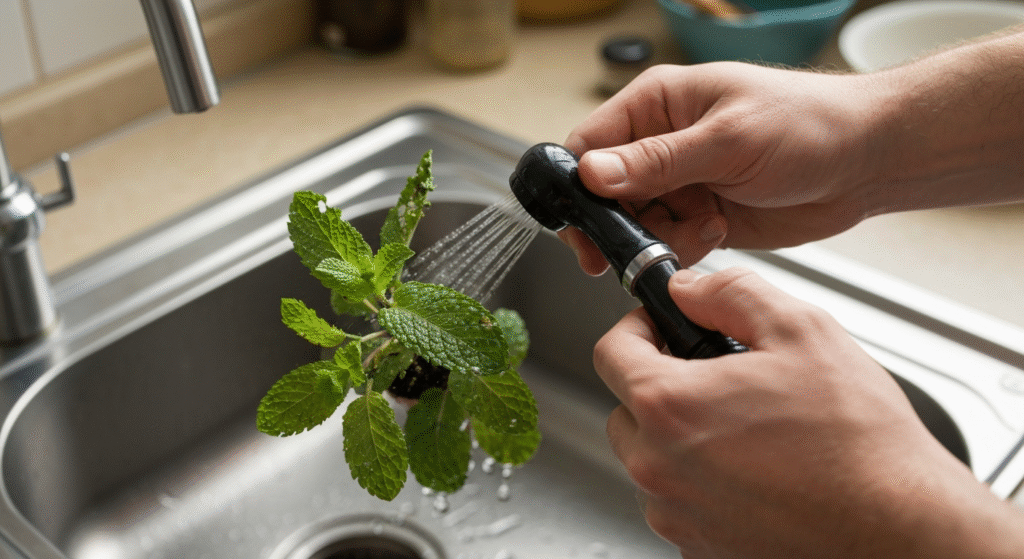
This is the most effective first step. I took my mint plant to the kitchen sink. I covered the soil with a plastic bag to keep the dirt from falling out, tipped the pot sideways, and used the kitchen sprayer to blast the leaves with lukewarm water.
You have to be thorough. I spent about five minutes turning the plant around, spraying the undersides of the leaves. This physically knocks the aphids off and washes them down the drain. Since aphids are slow and have soft bodies, they usually can’t climb back up.
2. Insecticidal Soap
Water gets most of them, but not all. For the survivors, I used a simple insecticidal soap spray. You can buy pre-made ready-to-use bottles, which I find easier for small spaces. I sprayed the plant down, ensuring I soaked the undersides of the leaves.
The soap works by drying out the bugs. It doesn’t poison them; it just messes up their outer shell. It’s safe to use indoors, but you have to actually hit the bug with the spray for it to work.
Important Note on Soap: Do not use dish detergent (like Dawn) if you can avoid it. It’s technically a detergent, not a soap, and it can strip the natural oils off your herb leaves, damaging the plant. Look for “Potassium Salts of Fatty Acids” on the label of garden sprays, or use pure Castile soap if you want to make your own.
The Invisible Webbers: Spider Mites
Spider mites are my nightmare. They are so small you barely see them until there are thousands of them. They aren’t actually insects; they are arachnids, related to spiders.
These pests love dry, warm air. That means they thrive in apartments during the winter when the heater is running. I lost a beautiful rosemary plant to spider mites because I caught them too late.
How I Identified Them
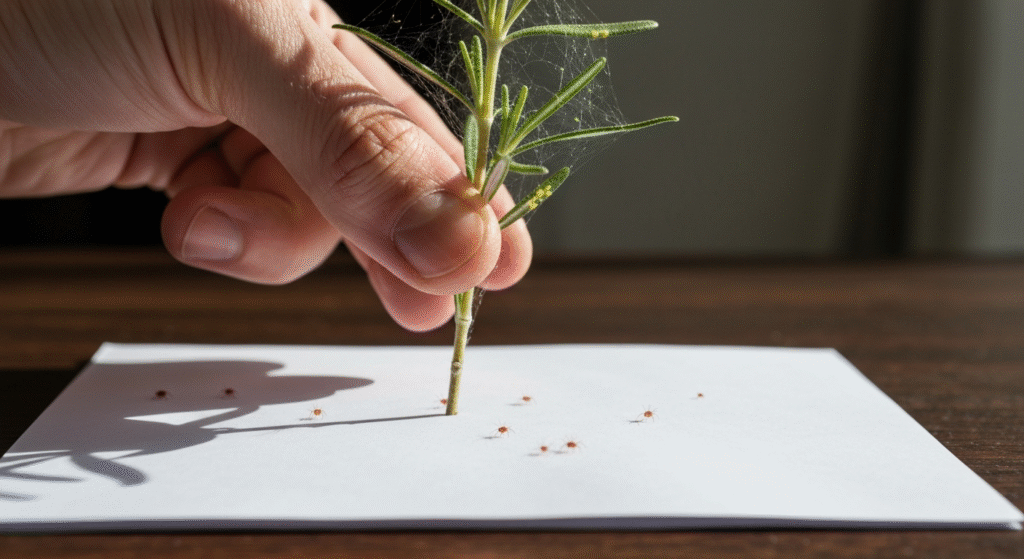
By the time you see webs, you have a bad infestation. The webbing usually appears between the leaf stems and the main branch. It looks like dusty, disorganized silk.
Before the webs appear, look for “stippling.” This looks like tiny yellow or white dots all over the leaves, as if someone poked the leaf with a pin hundreds of times.
The Paper Test:
If I suspect mites but can’t see them, I hold a sheet of white printer paper under a branch and tap the leaves gently. If tiny specks fall onto the paper and start crawling around (they look like walking periods), those are spider mites.
Increasing Humidity and Control
Since spider mites love dry air, my apartment in winter was their paradise. Here is how I fought back.
1. The Wipe Down
Unlike aphids, spider mites reproduce insanely fast. I started by taking a damp paper towel or a microfiber cloth and physically wiping down the leaves of my larger plants like rosemary. It’s tedious work, but it removes the webbing and a bulk of the population.
2. Neem Oil (With a Caveat)
Neem oil is an organic oil from the neem tree. It messes with the hormones of pests so they stop eating and mating. It works well on spider mites.
However, a warning from my experience: Neem oil smells strong. To me, it smells like a mix of sulfur, garlic, and peanut butter. It is not a pleasant scent for a small apartment. I only use this if I can put the plant in the bathroom with the fan on for a few hours, or if I can open a window.
If the smell is too much, the insecticidal soap mentioned in the aphid section also works on mites, though you have to be very consistent with it (spraying every 3-4 days for two weeks).
3. Raising Humidity
To prevent them from coming back, I started misting my herbs daily during the winter. I also grouped my plants closer together. Plants release moisture as they breathe, so grouping them creates a little micro-climate of humidity that spider mites hate.
Preventing Future Invasions
Dealing with bugs is exhausting. After fighting off these three waves, I became much more defensive about what I brought into my home. You can’t prevent every bug, but you can lower the odds significantly.
Here are the rules I live by now:
- The Inspection: I never buy a plant without looking under the leaves. If I see a single web or a sticky leaf at the store, I put it back. I also gently shake the pot; if white flies or gnats fly up, I walk away.
- The Quarantine: When I bring a new herb home, it does not go on the windowsill with my other plants. It goes on the kitchen table or a separate shelf for two weeks. This gives me time to see if any eggs hatch before they spread to my healthy basil.
- New Soil Only: I never reuse old soil from a dead plant for a new one. Old soil can harbor eggs or larvae. I always use fresh, high-quality potting mix for indoor containers.
For more detailed information on identifying pests that might be tricky to spot, I recommend checking out this guide on Managing Insects on Indoor Plants from the University of Minnesota Extension. They break down the life cycles in a way that helps you understand why you need to be consistent with treatment.
A Note on Patience
It usually takes me about two weeks to fully clear up an infestation. One treatment is rarely enough because eggs will hatch a few days later. You have to keep at it.
I used to get frustrated and think, “Why is this so hard?” But then I realized that by gardening, I’m participating in a natural cycle. Bugs want to eat the delicious herbs just as much as I do. The goal isn’t a sterile laboratory; the goal is a balance where the plants win.
Frequently Asked Questions
1. Should I just throw my plant away if it has bugs?
Not necessarily. If the plant is completely covered in webs or has lost all its leaves, it might be better to start over to save your other plants. But for a mild to moderate infestation, most herbs can recover fully with a little patience and the right treatment.
2. Can I use vinegar to kill the bugs directly?
I wouldn’t recommend spraying vinegar directly on the leaves. Vinegar is an acid and can burn the foliage, turning your green herbs brown. It’s okay for traps near the plant, but keep it off the leaves and soil.
3. Are these bugs harmful to humans or pets?
Generally, no. Aphids, fungus gnats, and spider mites are interested in plant sap and organic matter, not people or pets. They are annoying and can fly in your face, but they don’t bite humans or carry diseases that affect us.
4. How long does it take to get rid of them?
In my experience, it takes about 10 to 14 days to break the life cycle. You might kill the adults today, but eggs in the soil or under leaves might hatch in three days. You have to stay consistent with your traps or sprays for at least two weeks to make sure you get the next generation.
Final Thoughts
Don’t let a few bugs discourage you from growing your own food. I’ve had basil plants that looked terrible one month bounce back to provide pesto for the whole summer the next. It’s all part of the learning process.
Grab some sticky traps, check your watering habits, and keep a close eye on those leaves. You can win the battle for your windowsill.

